
The Fast funded account prop firm sector has seen an explosive growth in popularity. This has effectively put more traders in the funded evaluation pathways as prop firms provide traders with higher capital levels while personal capital requirements remain low.
On the other hand, traders are realizing that being consistent and emotionally disciplined during trading is key. Such changes in thinking have led many funded traders to focus less on scalping which is often associated with aggression and more on swing trading that is seen as a well-structured approach.
Consequently, an increasing number of traders are wondering what is swing trading and its advantages over scalping coming to prefer it in 2026.
Since swing trading allows for a more leisurely and controlled style of trading, it might be better suited to the new risk and consistency rules of prop firms.
EXPLAINING SWING TRADING
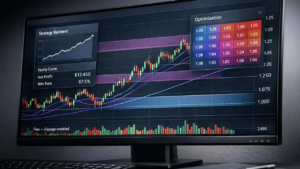
What is swing trading is likely one of the first questions a trader entering a funded trading environment would have.
Swing trading is a methodology which involves holding a trader’s position over a longer period of time (few days or weeks) so as to benefit from medium term trends and price changes in the market.
Scalping differs from swing trading in that it is very much focused on very short-term trades and rapid execution whereas swing trading is more about patience, timeframe analysis, and structured setups.
Aim is to achieve more substantial market moves whilst lowering the emotional strain of regular trading activities.
WHY SCALPING IS A CHALLENGE IN FUNDED TRADING
Scalping may seem very enticing due to its fast tempo and multiple trading opportunities. Nonetheless, in the environment of a Fast funded account prop firm, scalping may be a source of major problems.
Move after move, scalpers get affected by the changes and are continuously being pushed to make decisions emotionally, and also they are paying more for their trades with spreads and commissions.
In real-time, prop firms keep one underlying aspect constant which is the enforcement of very tight drawdown limits. Thus, aggressive scalping can very quickly lead to an account violation situation if a trader loses self-control.
Several traders recognize the fact that keeping up with scalping over long time is by far toughest.
THE ROLE OF SWING TRADING IN ENHANCING CONSISTENCY
Consistency is probably one main reason behind the preference of swing trading strategies in 2026.
From fewer, but higher quality setups skyrockets swing trading focus. So emotional pressure reduction and lesser exposure to the market would be the outcomes.
In a Fast funded account prop firm challenge, consis- tency is more appreciated than aggressive profits.
Being able to control one’s capital responsibly in prop firms’ eyes is a primary requirement of traders while swing trading is the third most natural propo- sition supporting this goal.
It is a well-established fact that market strength conditions tend to be stronger. Thus, swing traders by way of waiting patiently for these help avoid many impulsive and also typical mistakes of the scalpers.
BETTER DECISION-MAKING THROUGH HIGHER TIMEFRAME ANALYSIS
The 4-hour and daily charts are timeframes that swing traders could not do without.
Such a wide angle view of the market should allow traders to discern con- trasting trends, key levels of support and resistance, and the overall direction of the market.
However, scalpers often get confused and misled by very small time frame movements which cause emotional disturbances.
Execution of higher timeframe analysis helps anyways in a Fast funded account prop firm as it leads to better decisions and accounts to more stable performance.
Less Overtrading and Reduced Emotional Stress
Failure in funded evaluations often happens because of overtrading.
Scalping entails trading very frequently, which builds up emotional pressure and lures people into revenge trading after a losing trade.
Swing trading naturally minimizes this issue as the trades develop at a slower pace, and the setups are less frequent.
Swing Trading Makes Risk Management Simpler
While using swing trading, things like risk management become easier.
Without any form of risk control, swing trading is nothing more than a random holding of positions that is totally unplanned.
Typically, swing traders determine stop losses and work with stable risk-to-reward ratios as the main focus before going into a trade.
Since the trades are thought through thoroughly beforehand, the emotion-based decision-making is reduced significantly.
Trading Costs Are Less, Market Noise Is Minimized
Another reason traders go for swing trading rather than scalping in 2026 is that they want to lower trading costs.
The scalpers usually place a large number of trades daily, which leads to an increase in both commissions and spread costs substantially over a period of time.
The swing traders reduce their number of trades so as not to incur unnecessary costs and they are therefore able to maintain their account performance.
Besides that, trading on the higher timeframes diminishes one’s exposure to the random market noise, which is typically encountered in the scalping strategies on the lower timeframes.
This then results in the creation of more tranquil trading conditions and also more consistent execution.
Traders Gain Greater Work-Life Balance
Compared to scalping, swing trading also gives traders more scope for a flexible lifestyle.
Scalping is demanding because a trader has to constantly monitor charts and be ready to take any important decision very quickly during the trading session.
On the other hand, swing traders can simply wait for tranquil market conditions, enter trades in a methodical manner, and also not have to spend all day in front of the charts.
For the traders in the Fast funded account prop firm environment, this results in them being less stressed and having better control over their emotions.
In 2026, quite a lot of traders are choosing to go for sustainability instead of being in a state of constant high-pressure trading.
Typical Errors Made By Scalpers
The most significant mistake scalpers tend to make is to increase their position size after losing, as it is an attempt to recover the loss quickly.
Also, traders enter trades without confirmation, thinking it is good to make the trade impulsively.
An additional point is that some traders get emotionally very tired from being in the market all the time and this causes their ability to make decisions to change from one time to another.
Being in the Fast funded account prop firm challenge, these mistakes will only lead to the violation of the drawdown rules and hence result in the failure of the evaluation.
By introducing its elements of slowness into the trading, swing trading acts to eliminate these sorts of behaviors.
Prop Firms Are More Concerned With Discipline Than Profit
The goal of a Fast funded account prop firm is not to find those traders who are willing to take big risks in the hope of making quick profits.
Instead, prop firms are after those traders who are disciplined and can maintain their capital over the long term whilst also trading through the different market conditions.
Here’s why swing trading is a perfect match for these qualities as it forces a trader to be patient, to carry out the execution in a very systematic way, and to gain the emotional control.
Performing consistently is something that matters more to the prop firms than the aggressive performance that happens over a short period of time.
Concluison
Getting to know the ins and outs of swing trading allows traders to understand why it is the trading style of choice gaining more funding usage in 2026.
As in a Fast funded account prop firm, swing trading gives better emotional control, stronger risk management, greater reduction in overtrading and more consistent performance, compared with scalping.
Development of the ability to be patient, using higher timeframe analysis and being disciplined in the execution gives traders an edge in passing evaluations and being able to keep funded accounts long term.
Ultimately, it is ability to keep sustainable consistency that sets the funded traders who are successful apart from those who are short-term gamblers with emotions.
